4 is well known to be an unlucky number because 四 sounds similar to 死 (sǐ), which means "death" in Chinese. People will go to extremes based on superstitions of the number 4. Houses and apartments that have 4 in the address number will sell for much less than ones without. Mentioning the number four to an ill family member is considered to be highly offensive, and giving anything with 4 on it to someone can be seen as a death threat. Number 3 is considered a lucky number as it sounds similar to the character of 'birth' (生 shēng).

My ex-boss who was Chinese had a phone number with triple 8 at the end and she paid a considerable amount of money to get it. Because of its negative association with death, most people consider this number to be so unlucky that many buildings in China do not even have a "fourth" floor. The number 4 is also unlikely to appear on house/door numbers and car license plates.

Whenever, possible, many people will also try hard to avoid choosing telephone numbers that contain the number 4. Thirteen is considered unlucky by most Western cultures, because Judas Iscariot, the disciple and betrayer of Jesus, was the thirteenth man at Jesus' Last Supper. The belief is so strong that 13 is sometimes omitted as a house number or floor number in a building. However, thirteen is considered lucky in Italy.

It is also considered lucky in China, because it sounds like the word for "sure life". In a world where the majority of people don't identify themselves as particularly superstitious, it's astounding just how much impact superstitions about numbers can have on the economy. I was shocked to learn that businesses lose almost a billion dollars each time the 13th of the month just happens to fall on a Friday. While researching this article, I also learned that people in some Asian countries will pay a premium simply for a license plate or street address that contains a lucky number.
Manufacturers and retailers have caught on as well, assigning random prices to products that rely more on the inclusion of lucky numbers than on any retail strategy or research. If you've lived in a condominium in Metro Vancouver, you've likely noticed a few missing floor numbers along the way - it turns out that Vancouverites can count, after all. In Western cultures, the number 13 has been considered unlucky, and the number 4 is avoided in Chinese cultures for sounding similar to the word "death". Is well known to be an unlucky number because 四 sounds similar to 死 (sǐ), which means "death" in Chinese. Did you know that if you press a Chinese elevator button to go to the 50th floor of a building, you may actually only be going to the 35th floor? This is because many buildings in China not only omit the 13th floor, but are also missing any floor containing the number 4, which is considered to be the unluckiest number in Chinese culture.

The Chinese have many superstitions about numbers, often related to similar-sounding words in the Chinese language, which are called homophones. In Italy, the number 17 is as unlucky as 13 is to Americans — for very good reason. The Italians write 17 as XVII, which can be rearranged to form VIXI, which roughly translates to "I'm now dead" or "my life is over." Not a pleasant thought. Carmakers and other manufacturers avoid using the number when naming products or assigning model numbers, just in case.

Ironically, the dreaded 13 is actually considered lucky in Italy, despite its reputation in many other parts of the world. Every country and culture has its own superstitions, especially when it comes to numbers. In the US, for example, the number 13 is considered bad luck, and it's why you'll rarely see a 13th floor in hotels and some taller buildings. On the other hand, the number 7 is considered lucky, especially when there are three 7s in a row.

Like 5, 7 has both positive and negative connotations in Chinese culture. For the positive side, 七 sounds like both 起 (qǐ), which means "start" or "rise", and also 气 (qì), which means "vital energy". Seven is also seen as a lucky number for relationships. The Qixi Festival (七夕節), also known as the Chinese Valentine's Day, falls on the 7th day of the 7th month in the lunar calendar.

The 7th month is also known as the "ghost month" in China, where ghosts and spirits are believed to rise from hell to visit earth. While ghosts may be seen as omens, the ghost festival in the 7th month is widely celebrated. 7 may also be considered unlucky because 七 sounds like 欺 , meaning "cheat".
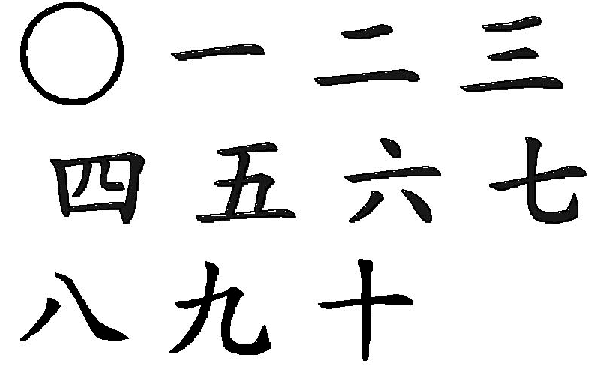
But the number four is considered unlucky because it sounds a lot like the word for "death," and as a result Chinese buildings often lack a fourth floor . Three lucky numbers are overrepresented on plate endings, with 12 or 13 percent each. In China, it is customary to regard even numbers as being more auspicious than odd ones.

So, gifts are given in even numbers for the celebration of all occasions. No. 8 has long been regarded as the luckiest number in Chinese culture. With pronunciation of 'Ba' in Chinese, no. 8 sounds similar to the word 'Fa', which means to make a fortune. It contains meanings of prosperity, success and high social status too, so all business men favor it very much. Moreover, in some areas of China, people prefer to pay much more money for a telephone number with 8 in it. They also favor residences on the eighth floor of buildings.

In 1990s, a vehicle identification number with 8 was once auctioned off for 5 million Hong Kong dollars. This number is a dreaded number in Chinese superstition and a very unlucky number. This is because it is almost homophonous with the Chinese word 'si' which means 'death'.

Therefore, numbered items in China such as phone numbers, car license numbers and room numbers omit number 4 in them. Similarly numbered products from China omit number 4 in them e.g. As Max Chang wrote in a 2017 Next Shark article, the number 4 is unlucky for Chinese because the word is a homonym to a Chinese word for death. So imagine, having a phone number that begins with "444" sounds like death-death-death. That is why the Chinese will request custom phone numbers for their businesses or homes, to avoid the number 4. On the other hand, it's considered fortunate if you have a phone number with an 8.

Four is the unluckiest number in Chinese numerology. The romanisation of the number is 'si', which sounds scarily similar to the word 'si', meaning 'death'. As such, the number should be avoided at any cost. The number is considered inauspicious in Japan and Korea as well, where the words 'four' and 'death' remain homophonous. The pronunciation of the number four in Japanese is very similar to the word death, and because of this, four has been considered bad luck in Japan, Korea and China.
It is considered very bad luck to give a gift that is made up of four pieces to someone. Many buildings in heavily Asian areas do not have a fourth floor, much like the way North American cultures treat the number 13. Additionally, this number represents the three stages in the life of humans - birth, marriage, death - that adds to its importance in Chinese culture. Thus, some buildings in East Asia omit floors and room numbers containing 4, similar to the Western practice of some buildings not having a 13th floor because 13 is considered unlucky.

Where East Asian and Western cultures blend, such as in Hong Kong, it is possible in some buildings that the thirteenth floor along with all the floors with 4s to be omitted. Thus a building whose top floor is numbered 100 would in fact have just eighty one floors. Similarly in Vietnamese, the number 4 (四) is called tứ in Sino-Vietnamese, which sounds like tử (死) in Vietnamese. 3 (三), pronounced san, is considered lucky due to its similarity in sound to the word that means birth. 6 (六), pronounced liu, is considered lucky as it sounds like the word that means 'to flow', and can indicate smooth progress in life.

Similar to 8, 6 is preferred in number plates and phone numbers. When a couple gets engaged, the man customarily offers a gift to the girl's family which is usually money and this gift signifies a harmonious life for the couple. The number 3 (三), is considered lucky because of its likeness in sound to the word that implies birth.

Also, this number speaks to the three phases in the life of people – birth, marriage, demise – that adds to its significance in Chinese culture. The pronunciation of number 5 in the Chinese language sounds like无 (wú), which means "not" and as such the number is considered unlucky. However, the number 5 represents the five elements of the Chinese astrology and it's important in traditional medicine, feng shui, martial arts…and it could be lucky number too. Whether inspired by biblical stories or the legends of ancient people, these so-called lucky or unlucky properties assigned to numbers have real meaning to many people. Based on little more than a story, where the origin is often unknown, people will alter travel plans, delay purchases or spend their life savings on lottery tickets. Wonder where these numbers earned their reputations?

Read on to learn about some of the most popular superstitions in the world of numbers. Be mindful of the numbers your images may convey. Often, numbers that are visible in the background of an image might be innocent in one country but provoke fear in another. For example, a photo of a soccer player with a big number 17 on his jersey might look fine to audiences in most parts of the world, but in Italy this number is considered very unlucky.

In fact, at the winter Olympics in Turin, the 17th curve on the bobsled track was referred to as "Senza Nome" instead of referring to it with the unlucky number 17. Also, make sure to check the number of people or items you are displaying in a given picture — the number can be viewed as unlucky in some markets. For some Vietnamese, it's considered bad luck to have 3 people in photos. In China, numerology is more than just a superstition, it's a lifestyle.

'Eight,' for example, is considered a lucky number, so lucky, in fact, that people will splash millions to have a string of eights on their license plates or in their phone numbers. Culture Trip explores which numbers are good and which are bad and what that might mean for you. Alternatively, the number 3 is generally considered lucky due to its similarity in sound to the word of birth.

This number represents the three stages of life of humans - birth, marriage and death, which adds to its importance in Chinese culture. In fact, the Chinese are so superstitious about numbers, that they will often spend big money for "lucky numbers" in their life. A man in Hangzhou listed his license plate, A8888, for $140,000 online.

In Chinese culture, people believe that lucky numbers can bring them good luck and fortune. Forget individual numbers — the very act of counting itself comes with a series of positive and negative superstitions. One folk remedy suggests that counting the number of warts on your body and revealing the number to a stranger will cause the warts to go away.

Of course, you should never count money, your children or your possessions, as this can make them go away as well. The same is true for livestock — like counting chickens before they hatch — as well as fish and gambling winnings. Some superstitious types claim that weighing babies at birth also brings bad luck, as does counting the stones in ancient monuments.

There are certain factors that dictate whether a number is auspicious or inauspicious. You determine the number's rank of fortune by its sound when enunciated. For example, the number four sounds like the Cantonese word for death and therefore is considered very inauspicious. People avoid having this number in their home addresses.
Perhaps it was first a kind of psychological response that gradually became an accepted norm. Your apartment number, your cell phone number, your license plate—all are avenues to invite good luck or protect against bad luck in Chinese culture. Chinese numerology is deeply rooted in symbolism and language. Apart from mainland China, ethnically Chinese people live all over the world and are unified by seeing numbers as important symbols.

In China, lucky numbers have pronunciations that are similar to words with lucky meanings. Number 8 holds huge significance as a lucky number. To a lesser extent 2, 6, and 9 are considered lucky. As well as these general number superstitions, fengshui and the Chinese zodiac dictate different number luck for different places/people. In general, 13 can be considered a "bad" number simply because it is one more than 12, which is a popular number used in many cultures. In fact, even in the present day, some buildings omit the 13th floor, jumping from the 12th to the 14th floor to avoid the anguish of triscaidecaphobics, or using 12A and 12B instead.

This also sometimes applies to house or room numbers . The Chinese society is well-known for its obsession towards number "8". Eight is the luckiest number to the Chinese as its pronunciation resembles the meaning of prosperity, wealth or fortune. Prior research estimating the marginal effect of "8" on winning bid prices of car plate numbers attributes the positive impact of "8" on bid prices to superstitious value. However, the estimated positive effect could also be attributed to Veblen goods and future resale consideration.

Thus, an upward bias might exist in prior research's estimation. Descriptive statistics results reveal that the majority of all "8" plates are won by Chinese bidders. However, regression results reveal that Chinese bidders have a lower estimated marginal effect of number eight than their non-Chinese counterparts. This implies that while number "8" is popular among the Chinese, this popularity does not translate into higher bidding prices. These findings suggest the roles of Veblen goods and future resale consideration should not be ignored in estimating the superstitious value in car plate numbers. Chinese dwell in superstitions and beliefs and have a huge dependence on numbers in their day to day lives.

They lay great emphasis on the use of numbers which, according to their culture, may be considered lucky or unlucky. In Mandarin, 7456 (qī sì wǔ liù) sounds like "to make me angry" (qì-sǐ wǒ -le), and 250 can mean "imbecile" and is sometimes used as an insult. Many customers do not want to visit an address that conveys something negative, and some might even consider it bad luck to send correspondence or make deliveries to such a location. Customers in the West might raise eyebrows at a product priced at $6.66, but people in many parts of the world would not.


No comments:
Post a Comment
Note: Only a member of this blog may post a comment.